
Best Value Available! 2026 Realistic Verified Free C-BCBAI-2509 Exam Questions
Pass Your Exam Easily! C-BCBAI-2509 Real Question Answers Updated
SAP C-BCBAI-2509 Exam Syllabus Topics:
| Topic | Details |
|---|---|
| Topic 1 |
|
| Topic 2 |
|
NEW QUESTION # 35
In SAP Business AI, what are some safeguards for protecting customer data? Note: There are 3 correct answers to this question.
- A. SAP-hosted AI infrastructure
- B. Clean core maintenance
- C. Tenant isolation
- D. Sustainability
- E. Consent-based model training
Answer: A,C,E
NEW QUESTION # 36
(How can Joule for ABAP development support developers? Note: There are 3 correct answers to this question.)
- A. By debugging ABAP programs
- B. By creating ABAP coding learning journeys
- C. By explaining ABAP code
- D. By generating ABAP business objects
- E. By creating unit tests
Answer: C,D,E
Explanation:
Comprehensive and Detailed Explanation From Exact Extract: Joule for ABAP development supports developers by explaining ABAP code to aid understanding of logic and structure, creating unit tests to automate testing and improve code quality, and generating ABAP business objects to accelerate development using the ABAP RESTful Application Programming Model (RAP). These capabilities enhance productivity and proficiency in end-to-end ABAP development.
Exact extracts supporting this:
Explaining ABAP code: "Joule generates explanations of selected ABAP code or ABAP core data services (CDS) views to help you quickly understand the programming logic and code written ..."sap.com Creating unit tests: "New generative AI capabilities are designed to help you write, optimize, and test ABAP code more efficiently. From generating code suggestions ..."community.sap.com (Implying unit test generation as part of testing efficiency.) Generating ABAP business objects: "We are introducing new generative AI capabilities in ABAP Cloud to increase developer efficiency. The first scope of features will cover business object ..."learning.sap.com "Generative AI for ABAP development. With new ABAP capabilities, Joule can now help ABAP developers be more efficient with their development ..."community.sap.com Other options are incorrect because:
Option D: Joule provides suggestions and automation but does not directly debug programs; debugging remains a developer task supported by tools like ADT.
Option E: Joule focuses on practical development assistance rather than creating educational learning journeys, which are handled by SAP Learning platforms.
Reference from Positioning SAP Business AI Solutions as part of SAP Business Suite documents or Study Guide: Based on SAP News articles like "Introducing Joule for Developers: AI-Powered Capabilities Across SAP" and SAP Help Portal for "Joule for Developers, ABAP AI Capabilities." These position Joule as an AI tool for ABAP within the SAP Business Suite, as covered in the C_BCBAI_2502 certification and learning journeys for generative AI in development.
NEW QUESTION # 37
(What are the main categories of using AI in Cloud ERP? Note: There are 2 correct answers to this question.)
- A. Process knowledge
- B. Profitability optimization
- C. Process-related decision optimization
- D. Productivity and efficiency
Answer: C,D
Explanation:
Comprehensive and Detailed Explanation From Exact Extract: The main categories of using AI in Cloud ERP are productivity and efficiency, which focus on automating tasks and streamlining workflows, and process-related decision optimization, which involves leveraging AI for better decision-making and outcome predictions in business processes.
Exact extracts supporting this:
"Challenges and benefits of Artificial Intelligence in Cloud ERP can be divided into two main categories: Process-related decision optimization; Productivity and efficiency."learning.sap.com
"These can be divided into two main categories: Process-related decision optimization."learning.sap.com (Implying the second as productivity and efficiency from context.) Other options are incorrect because:
Option C: Process knowledge is not identified as a main category; AI embeds knowledge but categories focus on optimization and efficiency.
Option D: Profitability optimization is a potential outcome but not a primary category; emphasis is on decision and productivity aspects.
Reference from Positioning SAP Business AI Solutions as part of SAP Business Suite documents or Study Guide: From the SAP Learning course "Positioning SAP Business AI," unit "Summarizing Key Solutions of Business AI," and "Understanding SAP Business AI for SAP S/4HANA Cloud," which categorize AI usage in Cloud ERP as decision optimization and productivity/efficiency, supporting positioning within the SAP Business Suite per C_BCBAI_2502 materials.
NEW QUESTION # 38
(What are some data sources Joule allows users to use? Note: There are 3 correct answers to this question.)
- A. Stack Overflow
- B. SAP Help
- C. Linkedin Learning
- D. Developer tutorials
- E. SAP Learning
Answer: B,D,E
Explanation:
Comprehensive and Detailed Explanation From Exact Extract: Joule, as an AI copilot, allows users to access and retrieve information from sources such as developer tutorials for technical guidance, SAP Help for product documentation and support, and SAP Learning for educational content and journeys. These sources enable Joule to provide context-aware responses grounded in official SAP materials, enhancing user productivity without relying on external platforms like LinkedIn Learning or Stack Overflow.
Exact extracts supporting this:
Joule is "integrated into SAP solutions for business-relevant processes" and can "retrieve information" from SAP ecosystems, including learning and help resources.learning.sap.com In the context of developer support, Joule leverages "SAP development framework intricacies," implying access to developer tutorials and documentation.news.sap.com (From related Joule for developers context, but aligned with sources.) Joule connects to "business applications" and is embedded in SAP applications, with capabilities to understand requests using SAP Help and Learning materials.help.sap.com community.sap.com Other options are incorrect because:
Option C: LinkedIn Learning is an external platform not integrated with Joule; Joule focuses on SAP-internal sources for trusted, business-grounded information.
Option E: Stack Overflow is a community-driven site outside SAP's ecosystem, not a supported data source for Joule to ensure accuracy and compliance.
Reference from Positioning SAP Business AI Solutions as part of SAP Business Suite documents or Study Guide: Derived from SAP Help Portal "Joule Capabilities" and SAP Community topics on Joule, which emphasize integration with SAP Help, developer resources, and SAP Learning for contextual assistance. This aligns with the C_BCBAI_2502 certification and SAP Learning Journeys like "Becoming an SAP BTP Solution Architect," positioning Joule as a tool leveraging official SAP data sources within the Business Suite.
NEW QUESTION # 39
(What are some functions that the SAP Build Code with code generation add-on provides? Note: There are 2 correct answers to this question.)
- A. Explain existing code
- B. Insert code snippets through Joule
- C. Generate unit tests for ABAP classes
- D. Refactor CAP projects
Answer: A,C
Explanation:
Comprehensive and Detailed Explanation From Exact Extract: The SAP Build Code with code generation add-on, powered by Joule, provides functions such as explaining existing code through code reviews and comments, and generating unit tests for ABAP classes by selecting methods and using AI-based features to create tests efficiently.
Exact extracts supporting this:
Explain existing code: "/cap-edit-model: Edits existing CAP data models, supports code reviews, adds comments, and answers questions like 'Does this code follow the best practices of CAP?'"community.sap.com "/ui5: Explains UI5-related artifacts, e.g., 'What does the code in the main controller do?', with options to consider selected code without specifying files."community.sap.com "Code Commenting via Joule Code Assistant, generating explanatory comments for selected code, with accept/reject options."community.sap.com Generate unit tests for ABAP classes: "With Joule for developers, ABAP AI capabilities, you can easily access AI-based features designed to help you create ABAP Unit tests."help.sap.com "Navigate to any of the specified views and select a public method from a global ABAP class. Open the context menu and select Joule Generate Unit Tests."help.sap.com Other options are incorrect because:
Option B: While Joule supports inline code-completion for suggesting snippets, this is a general feature rather than a specific function of the code generation add-on, which focuses on broader generation tasks like models and tests rather than snippet insertion.
Option C: Refactoring is supported for CAP projects through editing models and code refactor assistants, but it is not highlighted as a primary function of the code generation add-on, which emphasizes generation and explanation over refactoring.
Reference from Positioning SAP Business AI Solutions as part of SAP Business Suite documents or Study Guide: Based on SAP Community blogs like "Overview of all GenAI Options in SAP Build Code" and "Develop with Joule in SAP Build Code," as well as SAP Help Portal documentation on ABAP AI capabilities in SAP Build Code. These align with the C_BCBAI_2502 certification, positioning SAP Build Code as an AI-enhanced development tool within the SAP Business Suite for Java, JavaScript, and ABAP.
NEW QUESTION # 40
(What does business AI mean? Note: There are 3 correct answers to this question.)
- A. Enterprise data
- B. Agility
- C. Processes
- D. Technology foundation
- E. Customer centricity
Answer: A,C,D
Explanation:
Comprehensive and Detailed Explanation From Exact Extract: Business AI in SAP is defined as the combination of technology foundation (the underlying AI technology), enterprise data (the business data it leverages), and processes (the business processes it enhances and automates). This holistic approach ensures AI is embedded in business contexts for relevant, reliable, and responsible outcomes, with customer centricity and agility as resulting benefits rather than core components.
Exact extracts supporting this:
"What does SAP Business AI mean? Essentially three things: The technology it is based on. The enterprise data it is trained on. The processes it runs through."learning.sap.com Enterprise data: "Grounded in customers' business data."learning.sap.com Processes: "Embed AI features across all business processes, delivering immediate value to businesses."events.sap.com "Automating processes, and enabling predictive analytics."community.sap.com Technology foundation: "The technology it is based on."learning.sap.com "These AI functionalities are designed to help businesses automate processes, gain insights from data, improve decision-making."community.sap.com Other options are incorrect because:
Option B: Customer centricity is a benefit or principle in SAP solutions (e.g., in supply chain), but not a core definitional component of business AI.
Option D: Agility is an outcome enabled by business AI, such as increasing business agility, but not part of its fundamental definition.
Reference from Positioning SAP Business AI Solutions as part of SAP Business Suite documents or Study Guide: From the SAP Learning course "Discovering SAP Business AI," specifically the unit "Explaining the role of SAP Business AI," which defines business AI as the intersection of technology, data, and processes. Supported by SAP community blogs and product overviews, aligning with C_BCBAI_2502 certification for positioning AI in the SAP Business Suite.
NEW QUESTION # 41
Match the benefit from the dropdown list to the SAP LeanIX Al capabilities.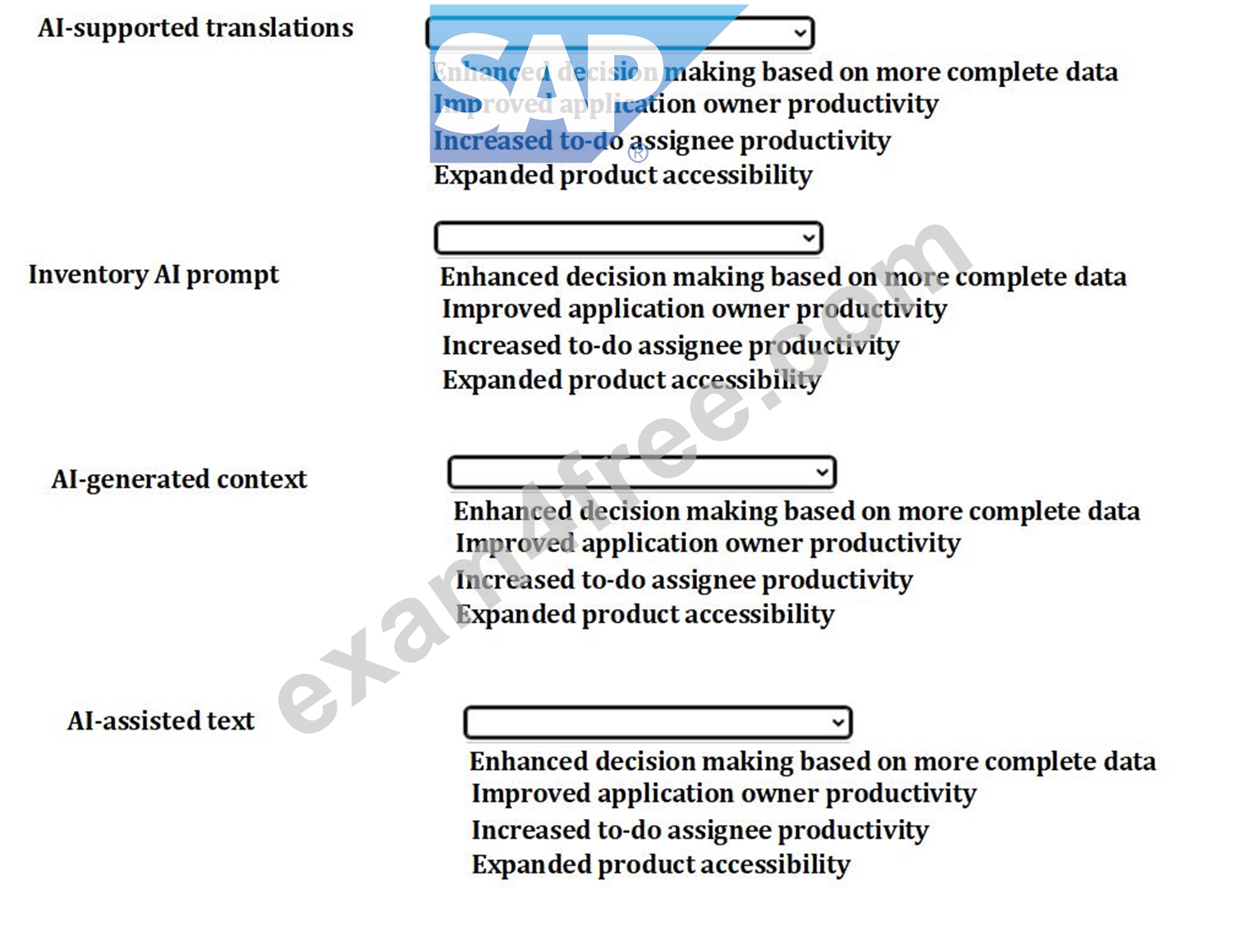
Answer:
Explanation: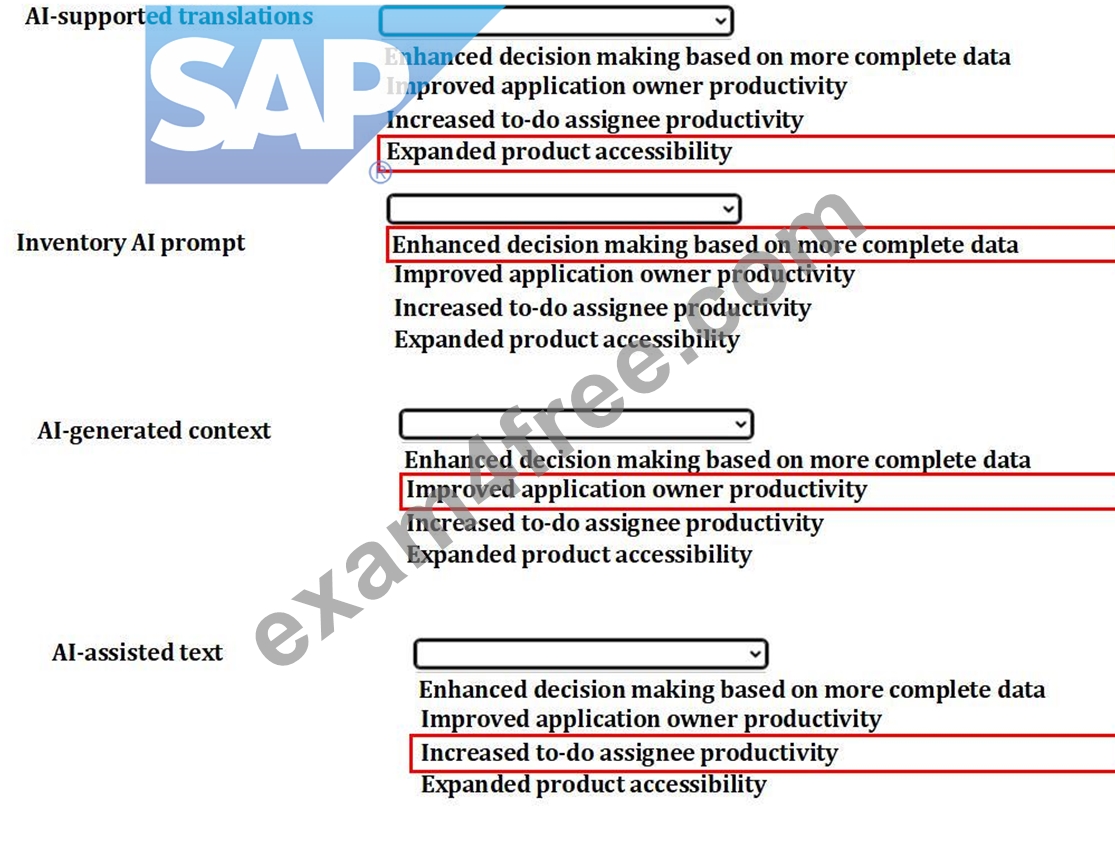
NEW QUESTION # 42
Drag and drop the elements at the bottom to the architecture layers of the SAP LeanlX meta model.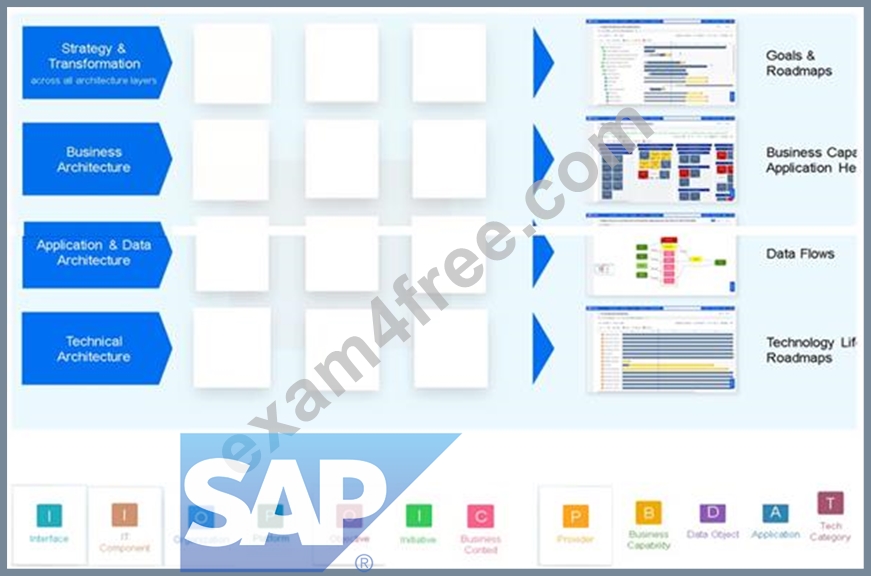
Answer:
Explanation: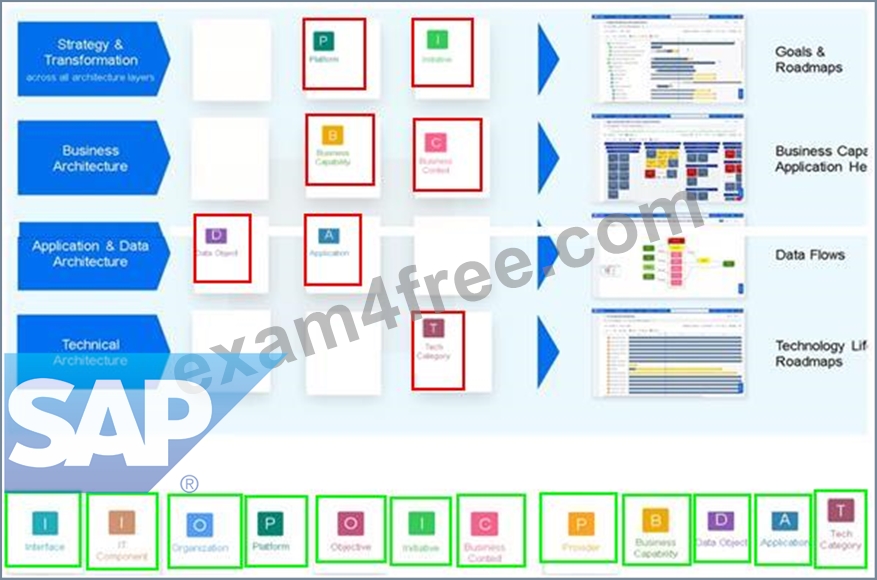
NEW QUESTION # 43
What is the semantic backbone of the AI Foundation that seamlessly links and context ualizes enterprise data for AI insights?
- A. Joule Studio
- B. Document grounding
- C. SAP Document AI
- D. SAP Knowledge Graph
Answer: D
NEW QUESTION # 44
You requested Joule to draft meeting talking points. Which way of interacting with Joule does this represent?
- A. Informational
- B. Transactional
- C. Chat talk
- D. Be creative
Answer: D
Explanation:
Drafting meeting talking points with Joule represents a be creative interaction pattern, as it involves generating original content based on user input, leveraging Joule's generative AI capabilities. According to SAP Business AI documentation, creative interactions with Joule include tasks like drafting documents, summarizing content, or generating ideas, which require natural language processing and contextual understanding. Informational interactions focus on retrieving data or insights, transactional interactions involve executing business processes, and chat talk is not a defined interaction mode in SAP's framework. Joule's ability to produce tailored, creative outputs enhances productivity by automating content creation tasks, making it a powerful tool for business users.
Reference:
---
NEW QUESTION # 45
Which of the following are included in SAP's Responsible AI framework? Note: There are 3 correct answers to this question.
- A. Human-centered design
- B. SAP Global Human Rights commitment
- C. ESG reporting
- D. Ethical governance
- E. Transparency and accountability
Answer: A,D,E
NEW QUESTION # 46
(What are some essential value propositions of SAP Business AI? Note: There are 3 correct answers to this question.)
- A. Use of the best technology on the market and strategic partnerships with industry leaders.
- B. Training of large multi-modal foundation models based on customer-specific business data.
- C. Deployment of Joule, an advanced Al copilot, to help interpret business data and provide intelligent responses to business inquiries
- D. Use of extensive business data extracted from areas including Finance, Supply Chain, Procurement, and Human Resources.
- E. Replacement of human workers with Al agents to reduce cost and human error.
Answer: A,C,D
Explanation:
Comprehensive and Detailed Explanation From Exact Extract: The essential value propositions of SAP Business AI emphasize its relevance through grounding in extensive business data across key areas like Finance, Supply Chain, Procurement, and Human Resources, reliability via utilization of leading technology and strategic collaborations with industry leaders, and transformative capabilities with tools like Joule, the advanced AI copilot that interprets business data and delivers intelligent responses to inquiries. These propositions position SAP Business AI as a solution that drives efficiency, innovation, and productivity without aiming to replace human workers but rather to augment them, while avoiding training foundation models directly on customer-specific data to uphold privacy and ethics.
Exact extracts supporting this:
Use of extensive business data: "AI is grounded in business data and embedded into every business function, driving impact... Industry-specific benefits: Drives value across functions like supply chain (agile, resilient, customer-centric), procurement (optimize spend, reduce risk), finance (manage risk, ensure compliance), HR (employee engagement, faster hiring)...".sap.com "With SAP Business AI, we are building the system of intelligence with three core principles: relevant, reliable, and responsible. Relevant SAP's AI...".news.sap.com "SAP Business AI provides reliable, accurate, and secure generative AI that is grounded in customers' business data...".learning.sap.com Deployment of Joule: "AI-powered scenarios: Access to over 230 AI-powered scenarios, expanding to 400 by the end of 2025, with Joule enabling navigational and transactional tasks up to 90% faster.".sap.com "Process procurement data searches 95% faster with Joule... Speed up HR tasks 90% faster with Joule in SAP SuccessFactors... Complete sales tasks 80% faster with Joule in SAP Sales Cloud.".sap.com Use of best technology and partnerships: "SAP Business AI provides reliable, accurate, and secure... we established an AI foundation...".learning.sap.com "Reliable: built on best technology and partnerships...".news.sap.com Other options are incorrect because:
Option B: SAP does not train large multi-modal foundation models on customer-specific data; instead, it grounds AI in business data using techniques like retrieval-augmented generation (RAG) to ensure privacy, as "Customer data is not shared with third-party large language model (LLM) providers for training their models." (from related ethics, but aligned with value props focusing on secure grounding rather than training).
Option E: SAP's propositions focus on augmentation and collaboration, not replacement, as "Solve complex challenges with AI agents that securely collaborate across your entire business... Helps teams get more done faster and more efficiently with AI that understands business processes and data.".sap.com Reference from Positioning SAP Business AI Solutions as part of SAP Business Suite documents or Study Guide: Derived from the official SAP Business AI product page and SAP Learning course "Discovering SAP Business AI," specifically units on articulating the value of SAP Business AI, which highlight relevance (data grounding), reliability (tech and partnerships), and tools like Joule as core propositions for integrating AI into the SAP Business Suite. Additional support from SAP News blogs on unlocking potential with SAP Business AI, aligned with C_BCBAI_2502 certification materials.
NEW QUESTION # 47
Match the key personas of an organization to the impact of SAP Business AI on their organization.
- A. Chief Financial Officer (CFO) → Improve financial efficiency, forecasting, and managing risk
- B. Chief Procurement Officer (CPO) → Improve sourcing, forecasting disruptions, and managing suppliers
- C. Chief Human Resources Officer (CHRO) → Enhance hiring, developing employees, and streamlining HR agility
- D. Chief Information Officer / CTO (CIO/CTO) → Integrate seamlessly with current technological infrastructure in a secure way
Answer: A,B,C,D
Explanation:
SAP Business AI delivers tailored impacts for key organizational personas, as outlined in SAP documentation. For the Chief Human Resources Officer (CHRO), AI enhances hiring, employee development, and HR agility through predictive analytics and automation in SAP SuccessFactors. The Chief Procurement Officer (CPO) benefits from improved sourcing, disruption forecasting, and supplier management via AI-driven insights in SAP Ariba. The Chief Information Officer/CTO (CIO/CTO) leverages seamless integration with existing infrastructure, ensuring secure and scalable AI adoption across SAP systems. The Chief Financial Officer (CFO) gains improved financial efficiency, forecasting, and risk management through AI-enhanced analytics in SAP S/4HANA. These persona-specific benefits demonstrate SAP Business AI's ability to drive value across diverse roles.
NEW QUESTION # 48
What are the main domain clusters of SAP's guiding principles for ethical AI? Note: There are 3 correct answers to this question.
- A. AI Ethics Steering committee
- B. AI System engineering
- C. Organizational practice
- D. AI System definition
- E. Executive Sponsorship
Answer: B,C,D
NEW QUESTION # 49
Your customer wants to deploy a generative AI model to summarize customer feedback across channels. Which AI Foundation component is best suited for this task?
- A. SAP Knowledge Graph
- B. Joule Studio
- C. Generative AI hub
- D. SAP Document AI
Answer: C
Explanation:
The Generative AI hub is the most suitable component within SAP's AI Foundation for summarizing customer feedback across channels. As per SAP Business AI documentation, the Generative AI hub provides enterprise-grade orchestration of generative AI models, enabling tasks such as text summarization, content generation, and natural language processing. This component is designed to handle large-scale, cross-channel data inputs, making it ideal for summarizing customer feedback. SAP Document AI focuses on extracting insights from structured documents, Joule Studio is a low-code environment for building AI applications, and SAP Knowledge Graph contextualizes data relationships but is not optimized for generative tasks. The Generative AI hub ensures secure, compliant, and scalable processing, delivering accurate summaries to support business decisions.
Reference:
---
NEW QUESTION # 50
......
Actual Questions Answers Pass With Real C-BCBAI-2509 Exam Dumps: https://dumpsvce.exam4free.com/C-BCBAI-2509-valid-dumps.html
