
[2026] Use Valid New Free 312-50v13 Exam Dumps & Answers
312-50v13 Braindumps PDF, ECCouncil 312-50v13 Exam Cram
NEW QUESTION # 87
In the bustling tech hub of Silicon Valley, cybersecurity investigator Elena Martinez found herself deep into a late-night investigation at Horizon Tech Solutions on July 7, 2025. The company had reported sporadic network disruptions affecting their research team's access to critical project files. Elena, working under the cover of a maintenance window from midnight to 3 AM PDT, began monitoring the internal network, focusing on a subnet reserved for the R&D department. She noticed a pattern of failed connection attempts logged just before each disruption, with multiple hosts reporting temporary IP address conflicts. Suspecting foul play, Elena deployed a discreet test to simulate an internal threat scenario. Shortly afterward, several workstations began showing unfamiliar gateway settings and redirected users to misleading login portals during routine access attempts. Despite these anomalies, no security alerts were triggered.
What type of attack technique did Elena most likely simulate?
- A. Packet Sniffing
- B. DHCP Starvation Attack
- C. MAC Flooding
- D. Rogue DHCP Server Attack
Answer: D
Explanation:
A Rogue DHCP Server attack best fits the symptoms because it directly explains unexpected gateway changes, IP conflicts, and traffic redirection to deceptive portals. In CEH network attack coverage, DHCP is a foundational service that automatically provides clients with IP configuration such as IP address, subnet mask, default gateway, and DNS servers. If an attacker introduces a rogue DHCP server on the same broadcast domain, clients may accept leases from the rogue server-especially if it responds faster than the legitimate DHCP infrastructure. Once that happens, the attacker can push a malicious default gateway or DNS server to victims. This allows redirection of traffic, man-in-the-middle positioning, and phishing-style interception, which matches the "unfamiliar gateway settings" and "misleading login portals" described.
The mention of "temporary IP address conflicts" also aligns: a rogue server can hand out addresses that overlap with legitimate allocations, causing intermittent connectivity issues and failed connection attempts.
While a DHCP starvation attack can create disruption by exhausting the DHCP pool, the key difference is outcome: starvation primarily denies service until a rogue server takes over. Here, the defining observable behavior is not just outage-it is misconfiguration and redirection, which points to the presence of a rogue DHCP server actively issuing malicious leases.
Packet sniffing alone would not change gateway settings, and MAC flooding is aimed at forcing switches to behave like hubs, not issuing IP configuration. Defensive controls include DHCP snooping, port security, network segmentation, and monitoring for unauthorized DHCP offers and anomalous lease patterns.
NEW QUESTION # 88
Kate dropped her phone and subsequently encountered an issue with the phone's internal speaker. Thus, she is using the phone's loudspeaker for phone calls and other activities. Bob, an attacker, takes advantage of this vulnerability and secretly exploits the hardware of Kate's phone so that he can monitor the loudspeaker's output from data sources such as voice assistants, multimedia messages, and audio files by using a malicious app to breach speech privacy. What is the type of attack Bob performed on Kate in the above scenario?
- A. aLTEr attack
- B. Spearphone attack
- C. Man-in-the-disk attack
- D. SIM card attack
Answer: B
NEW QUESTION # 89
An attacker gained escalated privileges on a critical server. What should be done FIRST to contain the threat with minimal disruption?
- A. Conduct a vulnerability scan on all servers
- B. Power down the server and isolate it
- C. Engage a forensic team immediately
- D. Monitor, analyze, and then isolate the server
Answer: D
Explanation:
CEH v13 follows the Incident Response Lifecycle, which prioritizes identification and analysis before containment, unless there is immediate risk of catastrophic damage. In this scenario, the attacker has escalated privileges, but the organization still needs to understand what actions are being taken, what systems are affected, and whether lateral movement is occurring.
Option C aligns with CEH v13 best practices. Real-time monitoring and documentation allow analysts to:
* Identify attacker techniques and tools
* Preserve volatile evidence
* Understand scope and impact
* Implement targeted containment
Immediately powering down the server (Option B) may destroy volatile forensic evidence and disrupt services unnecessarily. Engaging forensic teams (Option A) is important but premature without initial analysis.
Running vulnerability scans (Option D) does not address the active threat.
CEH v13 stresses that informed containment is more effective than reactive shutdowns. Therefore, Option C is correct.
NEW QUESTION # 90
In downtown Chicago, Illinois, security analyst Mia Torres investigates a breach at Windy City Enterprises, a logistics firm running an Apache HTTP Server. The attacker exploited a known vulnerability in an outdated version, gaining unauthorized access to customer shipment data. Mia's analysis reveals the server lacked recent security updates, leaving it susceptible to remote code execution. Determined to prevent future incidents, Mia recommends a strategy to the IT team to address this exposure.
Which approach should Mia recommend to secure Windy City Enterprises' Apache HTTP Server against such vulnerabilities?
- A. Eliminate unnecessary files within the jar files
- B. Conduct an extensive risk assessment to determine which segments of the network are most vulnerable or at high risk that need to be patched first
- C. Use a dedicated machine as a web server
- D. Block all unnecessary ports, ICMP traffic, and unnecessary protocols such as NetBIOS and SMB
Answer: B
Explanation:
The correct answer is D because the root cause of the breach was an unpatched, outdated Apache HTTP Server vulnerable to remote code execution. According to CEH principles under Security Operations and Incident Response, vulnerability management and risk assessment are critical components of defensive security strategy. An extensive risk assessment enables the organization to identify vulnerable assets, prioritize patching based on severity and business impact, and implement a structured remediation plan.
Risk assessment is part of the vulnerability management lifecycle, which includes asset identification, vulnerability scanning, risk evaluation, prioritization, patch management, and verification. By determining which systems are most exposed and critical, the organization can apply patches and security updates systematically, reducing the attack surface. Since the breach occurred due to a known vulnerability, proper patch management and regular security updates would have prevented exploitation.
Options A, B, and C represent hardening or segmentation techniques but do not directly address the core issue of outdated software vulnerabilities. Blocking ports and using dedicated machines are good security practices; however, they do not eliminate the risk of exploitation if the web server software itself remains unpatched.
Therefore, implementing a comprehensive risk assessment process followed by prioritized patch management aligns directly with CEH-recommended best practices for preventing similar future incidents.
NEW QUESTION # 91
During a penetration testing assignment, a Certified Ethical Hacker (CEH) used a set of scanning tools to create a profile of the target organization. The CEH wanted to scan for live hosts, open ports, and services on a target network. He used Nmap for network inventory and Hping3 for network security auditing. However, he wanted to spoof IP addresses for anonymity during probing. Which command should the CEH use to perform this task?
- A. Nmap -sS -Pn -n -vw --packet-trace -p- --script discovery -T4
- B. Hping3 -110.0.0.25 --ICMP
- C. Hping3-210.0.0.25-p 80
- D. Hping3 -S 192.168.1.1 -a 192.168.1.254 -p 22 -flood
Answer: D
Explanation:
The command C. Hping3 -S 192.168.1.1 -a 192.168.1.254 -p 22 -flood is the correct one to spoof IP addresses for anonymity during probing. This command sends SYN packets (-S) to the target IP 192.168.1.1 with a spoofed source IP (-a) 192.168.1.254 on port 22 (-p) and floods the target with packets (-flood). This way, the CEH can hide his real IP address and avoid detection by the target's firewall or IDS12.
The other commands are incorrect for the following reasons:
* A. Hping3 -110.0.0.25 --ICMP: This command sends ICMP packets (-ICMP) to the target IP 10.0.0.25, but does not spoof the source IP. Therefore, the CEH's real IP address will be exposed to the target.
* B. Nmap -sS -Pn -n -vw --packet-trace -p- --script discovery -T4: This command performs a stealthy SYN scan (-sS) on all ports (-p-) of the target without pinging it (-Pn) or resolving DNS names (-n). It also enables verbose output (-v), packet tracing (-packet-trace), and discovery scripts (-script discovery) with an aggressive timing (-T4). However, this command does not spoof the source IP, and in fact, reveals more information about the scan to the target by using packet tracing and discovery scripts.
* D. Hping3-210.0.0.25-p 80: This command sends TCP packets (default) to the target IP 10.0.0.25 on port 80 (-p), but does not spoof the source IP. Therefore, the CEH's real IP address will be exposed to the target.
References:
* 1: Master hping3 and Enhance Your Network Strength | GoLinuxCloud
* 2: Spoofing Packets with Hping3 - YouTube
NEW QUESTION # 92
A cybersecurity analyst in an organization is using the Common Vulnerability Scoring System to assess and prioritize identified vulnerabilities in their IT infrastructure. They encountered a vulnerability with a base metric score of 7, a temporal metric score of 8, and an environmental metric score of 5. Which statement best describes this scenario?
- A. The vulnerability has an overall high severity with a diminishing likelihood of exploitability over time, but it is less impactful in their specific environment
- B. The vulnerability has a medium severity with a diminishing likelihood of exploitability over time, but a significant impact in their specific environment
- C. The vulnerability has a medium severity with a high likelihood of exploitability over time and a considerable impact in their specific environment
- D. The vulnerability has an overall high severity, the likelihood of exploitability is increasing over time, and it has a medium impact in their specific environment
Answer: D
Explanation:
The Common Vulnerability Scoring System (CVSS) is a method used to supply a qualitative measure of severity for a vulnerability. CVSS consists of three metric groups: Base, Temporal, and Environmental. The Base metrics produce a score ranging from 0 to 10, which can then be modified by scoring the Temporal and Environmental metrics. A vector string represents the values of all the metrics as a block of text1 The Base metrics measure the intrinsic characteristics of a vulnerability, such as the attack vector, the attack complexity, the required privileges, the user interaction, the scope, and the impact on confidentiality, integrity, and availability. The Base score reflects the severity of a vulnerability assuming that there is no temporal information or context available1 The Temporal metrics measure the characteristics of a vulnerability that change over time, such as the exploit code maturity, the remediation level, and the report confidence. The Temporal score reflects the current state of a vulnerability and its likelihood of being exploited1 The Environmental metrics measure the characteristics of a vulnerability that depend on a specific implementation or environment, such as the security requirements, the modified base metrics, and the collateral damage potential. The Environmental score reflects the impact of a vulnerability on a particular organization or system1 In this scenario, the vulnerability has a Base score of 7, a Temporal score of 8, and an Environmental score of
5. This means that:
* The vulnerability has a high severity based on its intrinsic characteristics, such as the attack vector, the attack complexity, the required privileges, the user interaction, the scope, and the impact on confidentiality, integrity, and availability. A Base score of 7 corresponds to a high severity rating according to the CVSS v3.0 specification1
* The vulnerability has an increasing likelihood of exploitability over time based on its current state, such as the exploit code maturity, the remediation level, and the report confidence. A Temporal score of 8 is higher than the Base score of 7, which indicates that the vulnerability is more likely to be exploited as time passes1
* The vulnerability has a medium impact on the specific environment or implementation based on the security requirements, the modified base metrics, and the collateral damage potential. An Environmental score of 5 is lower than the Base score of 7, which indicates that the vulnerability is less impactful in the particular context of the organization or system1 Therefore, the statement that best describes this scenario is: The vulnerability has an overall high severity, the likelihood of exploitability is increasing over time, and it has a medium impact in their specific environment.
References:
* NVD - Vulnerability Metrics
NEW QUESTION # 93
Targeted, logic-based credential guessing using prior intel best describes which technique?
- A. Exhaustive brute-force testing
- B. Shoulder surfing
- C. Rule-less hybrid attack
- D. Strategic pattern-based input using known logic
Answer: D
Explanation:
This describes a rule-based or logic-based password attack, which CEH v13 classifies as a smart, targeted guessing technique. Attackers use known patterns-such as naming conventions, dates, or personal interests-to reduce the keyspace and increase success rates.
Option A accurately reflects this methodology. Option B is brute force, which is random and exhaustive.
Option C is physical observation. Option D describes hybrid attacks without structured logic.
CEH v13 emphasizes that pattern-based attacks are highly effective when attackers possess prior intelligence.
Therefore, Option A is correct.
NEW QUESTION # 94
A penetration tester evaluates the security of an iOS mobile application that handles sensitive user information. The tester discovers that the application is vulnerable to insecure data transmission. What is the most effective method to exploit this vulnerability?
- A. Execute a SQL injection attack to retrieve data from the backend server
- B. Perform a man-in-the-middle attack to intercept unencrypted data transmitted over the network
- C. Conduct a brute-force attack on the app's authentication system
- D. Use a Cross-Site Request Forgery (CSRF) attack to steal user session tokens
Answer: B
Explanation:
The CEH v13 courseware states that insecure communication occurs when mobile applications transmit sensitive data over unencrypted or weakly encrypted channels, exposing information to interception. When an application uses plain HTTP or does not properly validate certificates, attackers can place themselves between the client and server using a man-in-the-middle (MitM) attack. This allows them to read session tokens, credentials, API keys, or personal user data as it travels across the network. CEH materials emphasize that MitM attacks are the primary exploitation technique for insecure data transmission because they exploit weaknesses in transport-layer security rather than weaknesses in backend code or authentication mechanisms.
SQL injection and CSRF attacks target web application logic, not transport encryption. Brute-force attacks target authentication mechanisms and are unrelated to how data is transmitted. Therefore, the most effective exploitation method is intercepting traffic via MitM to capture or manipulate unencrypted communications.
NEW QUESTION # 95
In Boston, Massachusetts, network administrator Daniel Carter is monitoring the IT infrastructure of New England Insurance, a prominent firm, after receiving alerts about sluggish system performance. While reviewing traffic patterns, Daniel observes an unusual volume of concurrent requests overwhelming critical servers. To validate his suspicion of a session hijacking attempt, he begins capturing and reviewing live network traffic to identify unauthorized session behaviors before escalating to the security team.
What detection method should Daniel use to confirm the session hijacking attack in this scenario?
- A. Check for predictable session tokens
- B. Use an intrusion detection system (IDS)
- C. Perform manual packet analysis using packet sniffing tools
- D. Monitor for ACK storms
Answer: C
Explanation:
The scenario emphasizes that Daniel "begins capturing and reviewing live network traffic" to identify unauthorized session behaviors. In CEH-aligned network analysis practice, the most direct method to confirm session hijacking when you already have a packet capture is manual packet analysis using packet sniffing tools. By inspecting live traffic, Daniel can correlate sessions, verify whether multiple sources are reusing the same session identifiers, identify abnormal TCP sequence and acknowledgment behavior, and detect patterns such as duplicated cookies/tokens, replayed requests, inconsistent client IP or user-agent shifts, or sudden session reuse across hosts. This approach provides evidentiary detail beyond an alert and allows validation before escalation.
An IDS can be helpful, but it is a detection system that generates alerts based on signatures or anomalies; it does not inherently "confirm" the issue unless it provides clear supporting evidence, and the question specifically frames Daniel's action as hands-on traffic review. Checking for predictable session tokens is a preventive and diagnostic step for weak session management design, but it does not directly confirm an in- progress hijacking event from observed network behavior. Monitoring for ACK storms can indicate certain TCP-level hijacking/desynchronization conditions, but it is narrower and may not apply to application-layer session hijacking, which is far more common in enterprise environments and would be validated by inspecting session identifiers and request flows in the capture.
Therefore, given the described workflow and the need to confirm unauthorized session activity from live traffic, CEH methodology aligns best with manual packet analysis using sniffing tools.
NEW QUESTION # 96
What does a firewall check to prevent particular ports and applications from getting packets into an organization?
- A. Network layer headers and the session layer port numbers
- B. Presentation layer headers and the session layer port numbers
- C. Application layer port numbers and the transport layer headers
- D. Transport layer port numbers and application layer headers
Answer: D
Explanation:
Firewalls primarily operate at Layer 3 (Network) and Layer 4 (Transport) of the OSI model. They inspect:
IP headers (Layer 3)
TCP/UDP port numbers (Layer 4)
Application-specific data in Layer 7-aware firewalls (for application filtering) By examining transport layer port numbers and application layer headers, firewalls can block or allow traffic based on services like HTTP (port 80), FTP (port 21), and others.
Reference - CEH v13 Official Study Guide:
Module 13: Evading IDS, Firewalls, and Honeypots
Quote:
"Firewalls filter traffic based on IP addresses, transport-layer port numbers, and application protocol headers to control access to services and applications." Incorrect Options:
B & C. Presentation and session layers are not relevant to firewall rule inspection.
D). Application layer doesn't have port numbers; they are part of the transport layer.
NEW QUESTION # 97
Ben purchased a new smartphone and received some updates on it through the OTA method. He received two messages: one with a PIN from the network operator and another asking him to enter the PIN received from the operator. As soon as he entered the PIN, the smartphone started functioning in an abnormal manner.
What is the type of attack performed on Ben in the above scenario?
- A. Bypass SSL pinning
- B. Phishing
- C. Tap 'n ghost attack
- D. Advanced SMS phishing
Answer: D
Explanation:
In CEH v13 Module 17: Mobile and IoT Security, Advanced SMS Phishing (also known as SMiShing) is described as a technique where attackers impersonate trusted entities via SMS to:
Trick users into entering authentication codes or PINs.
Deliver malicious payloads or alter device configurations.
Simulate OTA (Over-the-Air) provisioning messages.
In this case:
The attacker sends a fake OTA setup message asking for a PIN.
Once Ben enters the PIN, the device's configuration is hijacked.
Why Others Are Incorrect:
B: Bypass SSL pinning: Relates to mobile app reverse engineering and traffic interception.
C: Phishing: General term; SMS-specific variant is more accurate here.
D: Tap 'n ghost: A touch screen manipulation attack, unrelated to messaging.
Correct answer is A. Advanced SMS phishing.
Reference:
Module 17 - Mobile Threat Vectors # SMS-Based Attacks
CEH iLabs: Simulating OTA Attacks and SMiShing on Android Devices
NEW QUESTION # 98
In the field of cryptanalysis, what is meant by a "rubber-hose" attack?
- A. Attempting to decrypt ciphertext by making logical assumptions about the contents of the original plaintext.
- B. Forcing the targeted keystream through a hardware-accelerated device such as an ASIC.
- C. A backdoor placed into a cryptographic algorithm by its creator.
- D. Extraction of cryptographic secrets through coercion or torture.
Answer: D
Explanation:
A powerful and often the most effective cryptanalysis method in which the attack is directed at the most vulnerable link in the cryptosystem - the person. In this attack, the cryptanalyst uses blackmail, threats, torture, extortion, bribery, etc. This method's main advantage is the decryption time's fundamental independence from the volume of secret information, the length of the key, and the cipher's mathematical strength.
The method can reduce the time to guess a password, for example, for AES, to an acceptable level; however, it requires special authorization from the relevant regulatory authorities. Therefore, it is outside the scope of this course and is not considered in its practical part.
NEW QUESTION # 99
A cybersecurity team at a regional healthcare provider is conducting an internal red team exercise to assess their exposure to service enumeration attacks. Amanda, a senior penetration tester, is assigned to probe the internal network for services that may reveal usernames, group information, or system details without requiring prior authentication. She decides to target common services running on specific ports that are often misconfigured or loosely monitored. During her reconnaissance, Amanda identifies several open ports across various hosts and must now prioritize which ones to probe first for maximum information gain related to enumeration. Which of the following services should Amanda target as a priority to enumerate usernames and group information without authentication?
- A. TCP 23 and UDP 137, 138
- B. TCP 139 and UDP 137, 138
- C. TCP 21 and UDP 137, 138
- D. TCP 25 and UDP 133
Answer: B
Explanation:
TCP 139 and UDP 137 and 138 correspond to NetBIOS over TCP/IP services that are closely associated with Windows file and printer sharing and legacy SMB browsing. In CEH methodology, these ports are high-value enumeration targets because NetBIOS name service and datagram service can disclose hostnames, domain or workgroup names, logged-in users, and shared resource details, often before any strong authentication occurs.
UDP 137 is used for NetBIOS Name Service, which supports name registration and lookup. UDP 138 supports NetBIOS Datagram Service, commonly tied to browsing and announcement traffic. TCP 139 supports NetBIOS Session Service, historically used to establish sessions for SMB traffic and to query share and user-related information when configurations are weak.
In real environments, misconfigurations such as permissive share settings, legacy protocols, or anonymous and guest-access allowances can allow an attacker to enumerate user accounts, groups, and policies indirectly through browsing data, share lists, and RPC-related exposure that frequently accompanies SMB environments. CEH training emphasizes prioritizing enumeration against Windows networking services because the information gained can rapidly support follow-on attacks such as password spraying, targeted phishing, lateral movement, and privilege escalation planning.
The other choices include TCP 21 FTP, TCP 23 Telnet, and TCP 25 SMTP, which may expose banners or allow limited user enumeration in specific configurations, but they are not the primary ports associated with classic Windows user and group enumeration. UDP 133 is not a standard enumeration target in this context.
Therefore, TCP 139 with UDP 137 and 138 is the best priority set for username and group-related enumeration.
NEW QUESTION # 100
John, a disgruntled ex-employee of an organization, contacted a professional hacker to exploit the organization. In the attack process, the professional hacker Installed a scanner on a machine belonging to one of the vktims and scanned several machines on the same network to Identify vulnerabilities to perform further exploitation. What is the type of vulnerability assessment tool employed by John in the above scenario?
- A. Agent-based scanner
- B. Cluster scanner
- C. Network-based scanner
- D. Proxy scanner
Answer: A
Explanation:
Agent-based scanners reside on a single machine but can scan several machines on the same network.
Network-based scanner
A network-based vulnerability scanner, in simplistic terms, is the process of identifying loopholes on a computer's network or IT assets, which hackers and threat actors can exploit. By implementing this process, one can successfully identify their organization's current risk(s). This is not where the buck stops; one can also verify the effectiveness of your system's security measures while improving internal and external defenses. Through this review, an organization is well equipped to take an extensive inventory of all systems, including operating systems, installed software, security patches, hardware, firewalls, anti-virus software, and much more.
Agent-based scanner
Agent-based scanners make use of software scanners on each and every device; the results of the scans are reported back to the central server. Such scanners are well equipped to find and report out on a range of vulnerabilities.
NOTE: This option is not suitable for us, since for it to work, you need to install a special agent on each computer before you start collecting data from them.
NEW QUESTION # 101
A penetration tester detects malware on a system that secretly records all keystrokes entered by the user. What type of malware is this?
- A. Ransomware
- B. Keylogger
- C. Worm
- D. Rootkit
Answer: B
Explanation:
CEH v13 explains that a keylogger is a type of spyware designed to capture user input covertly, often storing or transmitting captured data-such as passwords, emails, chat messages, and financial information-to an attacker. Keyloggers can be implemented as software, firmware, or hardware, and they operate silently in the background without affecting system performance, making them ideal for credential theft. CEH categorizes keyloggers under spying and monitoring malware frequently used in the System Hacking phase to escalate privileges or move laterally once credentials are harvested. Unlike rootkits, which hide processes, or ransomware, which encrypts files, a keylogger's main purpose is passive surveillance. CEH emphasizes how attackers deploy keyloggers post-compromise or use phishing/social engineering to trick victims into installing them. Their covert nature and ability to bypass traditional AV solutions by masquerading as legitimate processes make identifying them crucial during forensics and incident response activities.
NEW QUESTION # 102
The network in ABC company is using the network address 192.168.1.64 with mask 255.255.255.192. In the network the servers are in the addresses 192.168.1.122, 192.168.1.123 and 192.168.1.124. An attacker is trying to find those servers but he cannot see them in his scanning. The command he is using is: nmap
192.168.1.64/28.
Why he cannot see the servers?
- A. The network must be dawn and the nmap command and IP address are ok
- B. He needs to add the command ""ip address"" just before the IP address
- C. He is scanning from 192.168.1.64 to 192.168.1.78 because of the mask /28 and the servers are not in that range
- D. He needs to change the address to 192.168.1.0 with the same mask
Answer: C
Explanation:
https://en.wikipedia.org/wiki/Subnetwork
This is a fairly simple question. You must to understand what a subnet mask is and how it works.
A subnetwork or subnet is a logical subdivision of an IP network.The practice of dividing a network into two or more networks is called subnetting.
Computers that belong to the same subnet are addressed with an identical most-significant bit-group in their IP addresses. This results in the logical division of an IP address into two fields: the network number or routing prefix and the rest field or host identifier. The rest field is an identifier for a specific host or network interface.
The routing prefix may be expressed in Classless Inter-Domain Routing (CIDR) notation written as the first address of a network, followed by a slash character (/), and ending with the bit-length of the prefix. For example, 198.51.100.0/24 is the prefix of the Internet Protocol version 4 network starting at the given address, having 24 bits allocated for the network prefix, and the remaining 8 bits reserved for host addressing.
Addresses in the range 198.51.100.0 to 198.51.100.255 belong to this network. The IPv6 address specification
2001:db8::/32 is a large address block with 296 addresses, having a 32-bit routing prefix.
For IPv4, a network may also be characterized by its subnet mask or netmask, which is the bitmask that when applied by a bitwise AND operation to any IP address in the network, yields the routing prefix. Subnet masks are also expressed in dot-decimal notation like an address. For example, 255.255.255.0 is the subnet mask for the prefix 198.51.100.0/24.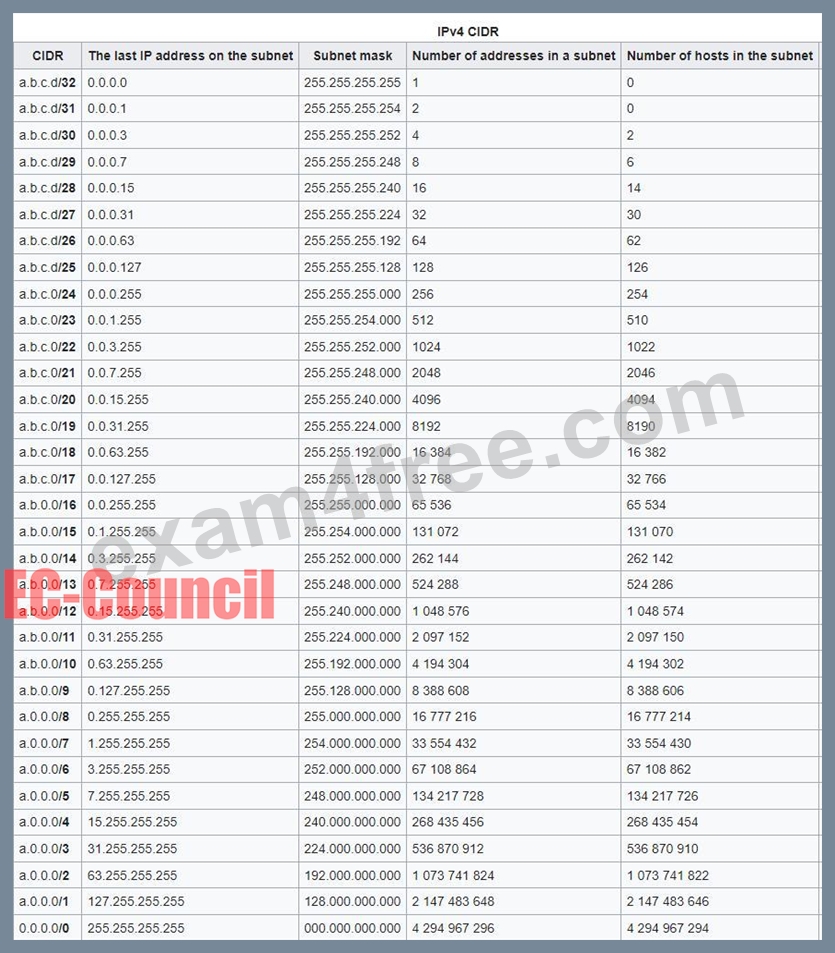
NEW QUESTION # 103
......
Feel ECCouncil 312-50v13 Dumps PDF Will likely be The best Option: https://dumpsvce.exam4free.com/312-50v13-valid-dumps.html
